December 15, 2025
Benefits of Laser Projectors vs OLED TVs
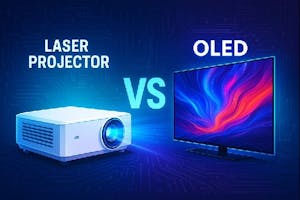
Laser vs OLED TVs: A Bigger Story Than You Think
By Jeremiah Barkman, Product Manager & Technology Writer
For most of my career, I’ve worked with display technology — evaluating specs, comparing product roadmaps, and helping teams decide what the future of big-screen viewing should look like. And if you asked me five years ago, I would have said OLED was the clear end-game. The blacks were perfect, the colors were cinematic, and everyone wanted that ultra-sleek slab on the wall.
But something changed.
People didn’t just want high-end picture quality anymore. They wanted flexibility, personality, and experiences that could transform rooms , and even their lifestyles. That shift is what pulled me deeper into the potential of laser projectors.
I’ve now used laser projection in more places and more ways than I ever expected. And I’ve seen, firsthand, how it delivers a different kind of value than traditional TVs. Not just technically, but emotionally.
Let me give you one small example.
A Halloween, a Projector, and a Line of Kids at My Door
Last October, I set up the InFocus Nemesis Quantum Laser Projector in my apartment window. I pointed it at a white curtain and played a haunting animated scene, flickering candles, drifting ghosts, the works. It turned the front of my building into a mini haunted house.
I didn’t hang a sign. I didn’t put out a single pumpkin.
But every kid walking by looked up, saw the spooky projection, and immediately knew: There be Candy is inside.
It became a magnet. A signal. A display that communicated something fun and interactive without ever being permanent. When the night ended, I pulled down the curtain, unplugged the projector, and my apartment went back to normal.
That’s the kind of utility a laser projector offers that no TV ever will.
We’ve Been Thinking Too Small About Screens
When people talk about OLED TV vs. projection, they tend to compare pixels and contrast ratios. But the real value of these technologies shows up in everyday living.
OLED TVs are fantastic — especially if you want the best visual fidelity in a bright, controlled environment. But it’s locked into its physical shape and size. It’s a fixture. It owns a wall in your home.
A laser projector? It adapts.
Tonight it’s a 150-inch cinematic experience. Tomorrow it’s a slideshow for work. Next week it’s a spooky welcome sign for trick-or-treaters.
And the economics just make sense. A 100-inch OLED can easily cost as much as a used car. Meanwhile, a comparable projection setup delivers immersive scale at a fraction of the price, especially as screen sizes increase.¹
On top of that, today’s laser illumination systems are bright, instant-on, and long-lasting, often rated between 20,000 and 30,000 hours of useful life.² And unlike OLED TVs, which can struggle with burn-in when static elements linger, laser projection doesn’t carry that risk.³
That means less worry, less maintenance, and more freedom to just use the thing.
Bigger Screens, Smaller Constraints
In my work, I’ve seen schools adopt laser projection because it can transform any white wall into an engaging teaching surface. I’ve watched businesses move projectors from room to room instead of buying multiple flat panels. I’ve helped customers set up home theaters without redesigning their living rooms.
Laser projection fits people, not the other way around.
It becomes what you need, when you need it. Then it puts itself away.
We’re entering an era where the screen no longer has to be a screen. It can be the whole wall. Or the side of a building. Or the backdrop to a memory your family will replay mentally for years.
That’s what excites me. That’s why I write about this technology. And that’s why I believe the future of big-screen entertainment isn’t a fixed rectangle. It’s a canvas that adapts to you.
Frequently Asked Questions
Are laser projectors cheaper per inch than OLED TVs?
Yes. Above 100 inches, projection delivers far more screen for the money.¹
How long do laser projectors last compared to TVs?
Laser projector light sources are commonly rated for 20,000 to 30,000+ hours.²
Can I move a projector around if I change rooms?
Absolutely. Portability and flexibility are key advantages of projection.⁴
Is the picture quality as good as OLED TV?
OLED still wins for right-out-of-the-box contrast and bright-room performance. But laser projection delivers immersion on a scale OLED can’t economically match.⁵
Is a laser projector really practical for everyday use, or just for home theaters?
This is one of the biggest misconceptions I see. Modern laser projectors are extremely practical. I’ve used them for movies, work presentations, casual TV watching, seasonal decorations, and even impromptu social gatherings. The idea that projectors are only for dark rooms and special occasions is outdated.6
Do laser projectors work in apartments or smaller spaces?
Yes. Short-throw and standard laser projectors can create large images even in tight spaces. In my own apartment, I’ve used one both indoors and through a window for outdoor projection. You don’t need a dedicated theater room to get value out of projection.7
What kind of wall or screen do I need?
You can start with a plain white wall. For best results, a proper projection screen helps, but it’s not a requirement. This flexibility is one of the reasons projectors feel more like a creative tool than a fixed appliance.8
Are laser projectors loud or distracting?
Modern laser projectors are much quieter than older lamp-based models. In normal viewing situations, fan noise fades into the background quickly and becomes a non-issue for most people.9
How long does it take to set up a laser projector?
Once you’ve done it once, setup can take just a few minutes. Many newer models include automatic focus, keystone correction, and instant-on laser light sources, which remove most of the friction people associate with projection. 10
Is gaming on a laser projector viable?
Absolutely. Many laser projectors support low input lag modes suitable for casual and even competitive gaming. The experience of gaming on a massive screen is something OLED simply can’t replicate at a reasonable cost. 11
References
- Cost-per-inch advantages of projection as screen sizes increase:
https://www.benq.com/en-us/campaign/gaming-projector/resources/tv-vs-projector-guide.html - Lifespan of laser projectors (20,000–30,000+ hours typical):
https://www.seenebula.com/blogs/buying-guides/how-long-do-projectors-last - OLED degradation and burn-in risks:
https://en.wikipedia.org/wiki/OLED - Flexibility of projection for residential/commercial use:
https://www.projectorreviews.com/things-to-consider-when-purchasing-a-laser-tv/ - Projection viewing experience vs emissive displays:
https://www.seenebula.com/blogs/how-to-select/projector-vs-tv - Practical everyday use of laser projectors
https://www.projectorreviews.com/projector-articles/laser-projectors-why-they-matter/ - Use of laser projectors in apartments and small spaces
https://www.benq.com/en-us/knowledge-center/knowledge/projector-for-small-room.html - Wall vs. screen requirements
https://www.projectorreviews.com/projector-reviews/do-you-need-a-projector-screen/ - Noise levels in modern laser projectors
https://www.projectorreviews.com/projector-reviews/projector-noise-levels/ - Ease of setup and automation features
https://www.projectorcentral.com/automatic-keystone-focus-projectors.htm - Gaming performance and input lag
https://www.projectorcentral.com/projector-gaming-input-lag.htm